
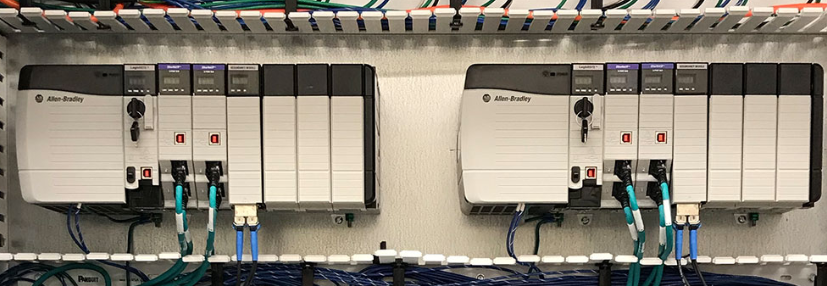

To answer the question, “What is PLC programming?”, it helps to define a PLC first. A programmable logic controller (PLC) is a ruggedized industrial computer used to automate machines and processes. It reads input signals from field devices (such as sensors, switches, and instruments), executes a user-defined control program, and updates output signals to command equipment (such as actuators, motors, valves, and drives). Most PLCs do this in a repeating, deterministic scan cycle (read inputs → run logic → write outputs), allowing for predictable real-time control in industrial environments.
PLCs are built specifically for industrial environments. Unlike general-purpose computers, they are designed to run continuously under conditions such as vibration, temperature extremes, humidity, and electrical noise. They typically use dedicated I/O modules and firmware engineered for reliable, time-consistent execution.
What is PLC Programming and the Languages Used?
PLC programming is the development, testing, and maintenance of control logic that runs on a programmable logic controller. It is typically implemented using standardized languages such as Ladder Diagram (LD), Function Block Diagram (FBD), and Structured Text (ST), and includes configuration of system elements such as tags, alarms, and input/output (I/O) mapping.
IEC 61131-3 Programmable Controllers—Part3: Programming Languages defines the standard programming languages for PLCs. The fourth edition, published in May 2025, recognizes the following:
- Ladder Diagram (LD) — A graphical language modeled on electrical relay schematics, using contacts and coils arranged on horizontal rungs. It remains the most widely used PLC language, particularly for discrete control and troubleshooting.
- Function Block Diagram (FBD) — A graphical language that connects predefined functional blocks, such as timers, counters, PID controllers, by lines representing data flow. It is well-suited for continuous process control and analog signal handling.
- Structured Text (ST) — A high-level text-based language with syntax similar to Pascal. It handles complex calculations, data manipulation, and algorithmic logic more efficiently than graphical languages.
- Sequential Function Chart (SFC) — A graphical language that organizes a program as a series of steps and transitions, similar to a flowchart. It is used primarily for batch processes and applications with clearly defined sequential phases.
- Instruction List (IL) — A low-level, assembly-like text language that was deprecated in the 2013 edition of IEC 61131-3 and formally removed in the May 2025 edition. It still appears in legacy systems but is no longer part of the current standard.
Industries That Rely on PLC Programming
When people ask, ‘What is PLC programming?’, these industries provide clear, real-world examples. PLCs play a key role across diverse sectors, providing reliable, flexible, and efficient automation that enhances safety, productivity, and quality in modern industrial environments. Below are just a few of the industries that highlight how PLC-based control systems are engineered, programmed, and brought together as complete automation solutions, from designing custom control panels to commissioning entire systems.
The PLC was initially developed for the automotive industry, and it remains one of its largest users. Assembly lines, robotic welding stations, press operations, parts conveyors, and inline quality inspection systems all run on PLC logic. A modern vehicle assembly plant may operate hundreds of individual PLCs coordinated across a production floor.
PLC programs manage the startup and shutdown sequences for grain leg elevators, drag conveyors, belt conveyors, distributors, and spouting, each device interlocked with the next to prevent material backups, equipment damage, or dust ignition hazards. A leg cannot run unless the conveyor below it is already running; the PLC enforces this logic automatically on every start.
PLCs manage critical functions such as motor speed control, conveyor synchronization, product tracking, and sorting operations. In grain applications, bin level monitoring, load-out control, scale integration, and rail car or truck loading sequences are all managed through PLC logic tied to an HMI that gives operators visibility into the entire elevator system from a single interface. High-throughput applications, such as automated train loadouts, depend on precise PLC timing to move grain from storage to railcars at rates that minimize dwell time.
The entire conveyor system in an industrial paint line is PLC-controlled. In powder coating and liquid paint finishing systems, the PLC manages conveyor speed, zone temperatures, part tracking through pretreatment, spray, and cure stages, and the sequencing of washers, ovens, and cooling sections. The system is programmed for each part type in the production series. A technician sets optimal spraying parameters, gun positioning, and movement speed relative to the parts. If the conveyor speed changes, the automatic system adjusts the movement of the manipulators and spray parameters to maintain a consistent coating thickness.
Friction-driven conveyor systems, where individual carriers can be stopped, held, or rerouted independently of one another, require more complex PLC logic than simple monorail systems. Each carrier position must be tracked, each process zone timed, and exceptions handled without stopping the rest of the line. This is where well-structured PLC programming directly affects both product quality and throughput.
Airport baggage handling systems are among the most demanding PLC applications, requiring real-time tracking and extensive system integration. With PLC control systems, operators have complete control of a baggage handling system, from programming specific machinery to ensuring that elements of the airport conveyor system run smoothly and in sync.
Low-level controls in baggage handling systems are based on PLC, and high-level controls are based on fault-tolerant servers running Supervisory Control and Data Acquisition (SCADA) and Sort Allocation Controller (SAC) software. These systems are designed to operate 24 hours a day, 365 days a year. The PLC layer handles conveyor motor control, diverter actuation, jam detection, and zone speed management. The SAC layer above it handles flight-based sortation logic. PLC programmers working in baggage handling must write code that efficiently handles faults such as a jammed belt or a failed diverter, to prevent them from impacting the rest of the system.
Parcel and Distribution Automation
Parcel sortation and fulfillment automation shares many characteristics with baggage handling but operates at higher speeds and with greater product variability. Conveyor systems in distribution centers must handle packages of varying weights, dimensions, and fragility, and must be sorted to correct destinations within tight timing windows.
PLCs manage motor speed control, conveyor synchronization, product tracking, and sorting operations. Their ability to process complex logic in milliseconds makes them ideal for high-speed applications where precision and timing are crucial. In large distribution centers, PLC systems also interface with warehouse management systems (WMS) to receive sort instructions and report throughput data. This requirement drives the need for Structured Text programming and ERP/database integration alongside the core ladder logic.
Data Centers
Data centers rely on PLC programming to control and interlock mission‑critical mechanical and electrical systems where uptime and predictable operation are essential. While higher-level platforms such as BMS, DCIM, or SCADA provide centralized monitoring, PLCs execute the real‑time, deterministic control logic at the equipment level.
PLCs are commonly used to control generators, automatic transfer switches (ATS), UPS systems, chillers, pumps, cooling towers, air handling units, and fuel systems. PLC programs manage startup and shutdown sequencing, redundancy coordination (such as N+1 systems), permissive interlocks, and fault handling to ensure equipment operates safely and responds correctly to abnormal conditions.
In cooling systems, PLC logic coordinates multiple pieces of equipment to maintain temperature and humidity within tight tolerances as IT load changes. In electrical systems, PLCs enforce safe power transfer and load management during utility disturbances. Well-structured PLC programming in data centers supports reliability, maintainability, and continuous operation in environments where downtime is not an option.
How Kasa Controls Transforms Industrial Automation
Kasa Controls helps manufacturers and industrial operators deliver PLC-based automation from concept through startup. Services often include control panel design/build, PLC and HMI/SCADA development, and on-site commissioning to validate sequencing, interlocks, alarms, and safe operation.
Across industries like automotive, grain handling, industrial finishing, baggage handling, and parcel distribution, Kasa Controls applies the same fundamentals: build clear, deterministic PLC logic that keeps equipment running safely and back it up with commissioning support, troubleshooting, upgrades, and documentation. In other words, “What is PLC programming” in the real world is as much about long-term reliability and maintainability as it is about writing the initial logic.
Contact Kasa to learn more and discover how our PLC automation solutions can optimize your operations, improve reliability, and help you achieve your productivity goals.