
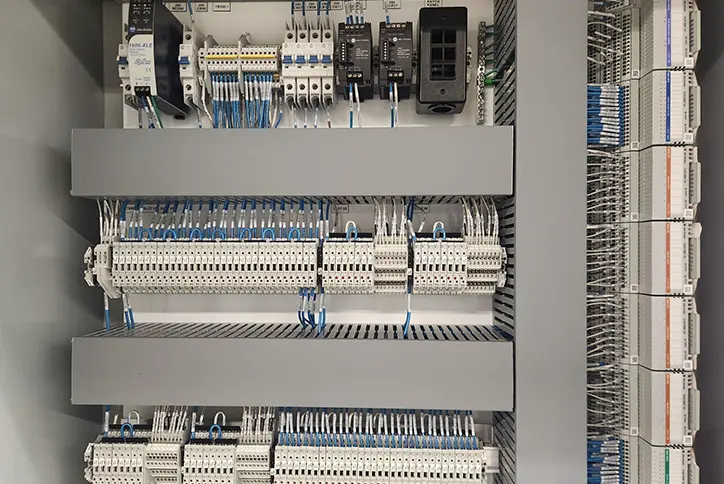

Custom electrical control panels will only be as useful as the information used to specify them. Your team must answer many questions before the design can be quoted, built, labeled, and commissioned correctly. The control panel builder needs site-specific input, because the required ratings, enclosure design, component choices, records, and startup plan all depend on where and how the panel will be used.
When those inputs are missing, the builder may make assumptions, which may not become visible until inspection, installation, startup, or maintenance, when corrections cost more and take longer to resolve. Use the questions below to collect the information your team needs to provide and to confirm how the panel builder will turn those inputs into a controlled, documented build.
What Is The Available Fault Current At The Installation Site?
This is the first question because the answer sets the panel’s short-circuit current rating (SCCR), and the SCCR governs component selection through the rest of the build. The SCCR is the largest fault current that the panel can withstand without becoming a fire or shock hazard. It is set by the lowest-rated component in the fault-current path, so one terminal block or contactor rated at 5 kA pulls the whole assembly down to 5 kA no matter how robust everything else is.
The National Electrical Code (NEC) section 409 requires an industrial control panel to be marked with its SCCR, and it prohibits installing a panel where the available fault current exceeds that rating. The available fault current at a control panel depends primarily on the utility transformer (or facility transformer) feeding the system, its size and impedance, and the conductors between the transformer and the panel. Larger transformers and shorter, larger conductors generally result in higher available fault current. Unless the purchase order says otherwise, you supply this value to the builder, because it comes from your installation and not from the panel builder.
A common mistake is assuming the interrupting rating of the main breaker is the same as the panel SCCR. The panel SCCR must be determined for the complete assembly using component ratings, tested combinations, or the calculation methods in UL 508A Supplement SB. A panel that contains only control-circuit components does not require an SCCR, but once power-circuit components such as disconnects, motor starters, or power distribution components are included, the panel must be marked with its SCCR.
If you cannot get an exact fault current number, ask the panel builder to design for a conservative SCCR. Current-limiting fuses are commonly used to reach higher SCCRs, but they do not raise the panel rating by default. They must be applied in accordance with UL 508A, using the correct feeder location, fuse let-through data, and downstream component ratings.
Which Standard Governs The Build?
The standard decides which components are allowed, how the panel is wired and spaced, and where it can legally ship, so it is important to know before the build begins. In North America, UL 508A covers construction of the panel itself and sets specific requirements for component ratings, wiring, and the SCCR marking. Many owners, insurers, and authorities having jurisdiction require or prefer a UL 508A listed panel because the listing gives a clear inspection path. The UL label gives the inspector evidence that the panel was built by an audited shop using components evaluated for that type of assembly. Without it, approval can be delayed, or the panel may require field evaluation.
If the panel ships to Europe or another international site, the approval path may be based on IEC standards and CE conformity rather than UL 508A listing. IEC-based designs use different component standards, markings, documentation, and conformity requirements. A panel built only to IEC requirements may not meet the inspection or customer acceptance requirements for a U.S. installation without redesign or component changes.
What Environment Will The Enclosure Live In?
The enclosure rating tells the panel builder what the box must protect against, such as dust, rain, hose-directed water, corrosion, or incidental contact. In North America, those ratings are commonly specified as NEMA Type numbers under ANSI/NEMA 250. The number is not a simple good-better-best ranking, so a higher number does not automatically mean a tougher enclosure. Each NEMA Type is tied to a specific environment, which is why a NEMA 12 enclosure can work well on a dry factory floor but fail quickly outdoors in wind-driven rain.
The rating describes the enclosure as installed. Door hardware, gland plates, and any field-drilled openings have to preserve the rating, so a Type 4X enclosure (intended for outdoor use with corrosion resistance) with an unsealed cable penetration is no longer Type 4X. Material selection should match the environment as well. Painted steel is common indoors, while stainless steel is used for corrosive, washdown, or outdoor service. Confirm both the NEMA Type and the enclosure material, because the rating alone does not tell the full story.
How Much Heat Will The Panel Generate, And How Will It Leave?
High internal temperature reduces the life and operating margin of electronics, power supplies, drives, relays, and insulation systems. The allowable internal temperature comes from the rated ambient temperature and derating data for the installed components. If the panel runs above those limits, the result may be nuisance drive trips, shortened component life, or early failure.
The design should start with a heat-load calculation, not a chosen fan size. Every drive, power supply, transformer, PLC, relay, and similar device converts part of its input energy to heat, and the manufacturer datasheet usually lists that loss in watts. Summing those losses, then adding solar gain for any sun-exposed enclosure, gives the cooling system a real number to work from.
The cooling method should follow the heat load rather than defaulting to a fan. Low-heat panels may rely on natural convection, while moderate loads may use filtered ventilation if the surrounding air is clean enough. Sealed or high-density enclosures in hot ambient conditions may need an air-to-air heat exchanger or a closed-loop air conditioner instead. A filtered fan can compromise a sealed Type 4X enclosure, so confirm the cooling method before layout instead of treating it as a late add-on.
Have Long-Lead And Obsolescence-Prone Components Been Identified?
Long lead time components and obsolescence can impact the build schedule for custom electrical control panels if not planned for. Identify long-lead parts before the design is complete so they can be ordered early or engineered around. Obsolescence is the slower version of the same problem. Many components reach end of life long before the equipment does. Obsolescence can force last-time buys, premium sourcing, and eventually redesign and re-qualification.
Identify any components already flagged as not recommended for new designs or near end of life. Ensure the design uses a current, supported PLC platform rather than one a few years from discontinuation, since building a new panel around a legacy controller inherits its sourcing problem on day one. Ask the builder to name substitutes for anything on the watch list before the design freezes.
What Documentation Arrives With Custom Electrical Control Panels?
Documentation is part of the control system. A panel without accurate records becomes difficult to troubleshoot, which shows up as longer downtime and higher maintenance costs across the life of the equipment. Revision histories are also critical, so maintenance teams know which file reflects the installed panel. Specify the package in the purchase order, because the useful documents are frequently treated as optional and then never produced.
A complete record package generally includes the following, and each item is worth confirming before you order:
- Drawing list and bill of materials with manufacturer part numbers.
- Power distribution and grounding drawings.
- Schematics organized by signal flow, with I/O lists and field termination drawings.
- Interior layout with dimensions and wire routing.
- Nameplate and wire-tag schedules, with the SCCR recorded on the nameplate and in the drawing set.
One of the most important items to confirm is the as-built drawing set. These drawings record what was actually wired, labeled, and configured after shop testing, field installation, and commissioning changes. The original design drawings may no longer be accurate once terminals are moved, I/O assignments are changed, or field wiring corrections are made. Updated as-built drawings, I/O lists, and the final PLC configuration let the next technician service the panel without tracing every circuit from scratch. Call out as-built deliverables in the purchase order, including the format, revision method, and timing for final delivery.
Who Commissions the Electrical Control Panel?
Shop testing can verify panel construction, wiring, labeling, and basic function before shipment, but commissioning verifies the panel as installed. Field wiring, connected loads, sensors, grounding, and site power all enter the picture during startup. A mislabeled field cable, an input wired to the wrong terminal, or a power circuit energized out of sequence can damage equipment quickly if startup is not controlled.
Before ordering custom electrical control panels, agree on who leads commissioning and what the checklist covers. A controlled startup usually begins with a pre-power inspection, including field wiring checks against the drawings, terminal torque checks on power connections, grounding verification between subpanels, and confirmation that protective devices are set correctly. The system should then be energized in stages with downstream loads disabled where appropriate, so wiring or configuration problems are found before they affect drives, PLC modules, motors, or connected equipment. Clarify whether commissioning is handled by the panel builder, your maintenance team, the machine builder, or a systems integrator, and make sure the final documentation reflects any changes made during startup.
Choose Kasa For Your Custom Electrical Control Panels
Kasa builds custom electrical control panels to UL 508A, with UL 698A for hazardous location applications and C-UL 508A for installations that fall under the Canadian Electrical Code. Builds also follow NEC (NFPA-70) requirements and support NFPA-79 when the panel is part of industrial machinery, so the SCCR marking, enclosure selection, and wiring methods align with the code the panel will be inspected against.
Every panel goes through engineering review before production, which catches conflicts between customer prints, component ratings, and code requirements before they reach the shop floor. Kasa builds to your prints or finalizes the design, then wires, labels, and tests each panel in a 40,000-square-foot environmentally controlled facility with on-site production engineering and factory acceptance testing. The documentation package, custom labels and tags, and certified wood crates ship with the panel.
Contact Kasa to review your requirements for custom electrical control panels and request a quote.