
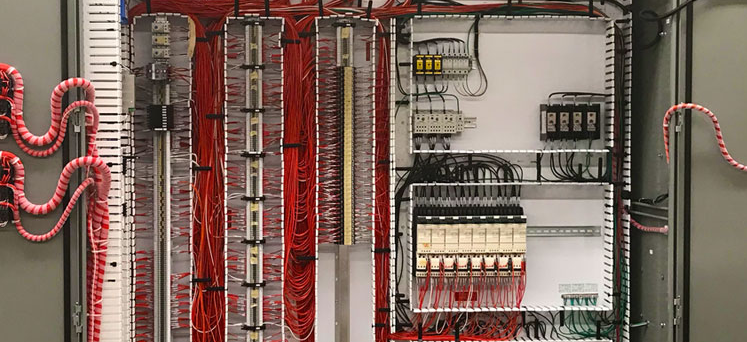

Custom control panels deliver essential functions for industrial automation. These systems enable manufacturing lines to operate complex machinery and maintain building operations. Custom control panel builds involve a wide range of designs and components because each application has specific requirements. With end results and requirements in mind, engineering addresses enclosure selection, component layout, wiring, and labeling, while meeting strict standards and customer specifications. This guide presents key principles of custom control panel construction, offering practical insights for planning, designing, and assembling panels that support both performance and maintenance.
What Is a Custom Control Panel?
A custom control panel is an enclosure that houses electrical components for controlling, monitoring, and managing industrial machinery or processes, tailored to a specific application. It serves as a centralized location where inputs (e.g., sensors, switches) are used to process logic and generate outputs (e.g., signals sent to motors and actuators).
A custom build is assembled based on engineering drawings or customer specifications. It includes enclosure preparation, component mounting, wiring, labeling, and testing. Unless explicitly included in the project scope, PLC programming, machine design, field installation, and system commissioning generally fall outside the scope of panel building.
Building to Customer Prints or Specifications
Many customers provide electrical schematics, bills of materials, and panel layouts, while others need a builder to review or finalize designs before production.
If designing your own control panel, keep the following in mind:
- Ensure your drawings are properly scaled so components fit within the enclosure as planned
- Consider the space required for and around your panel, including obstructions and door clearance when open
- Verify whether your design meets applicable certification and code requirements
- Consider environmental factors for outdoor control panels or those that are in harsh environments
- Plan space and capacity for potential future components and expansions.
Verify that your control panel builders will conduct an engineering review before starting the build to prevent delays and errors. This review typically includes:
- Engineering review of drawings
- Component verification
- Bill of materials confirmation
- Compliance checks
Enclosure Preparation and Component Installation
Control panel building begins with enclosure preparation. The enclosure is modified to accommodate devices, cable entries, and cooling components.
Typical enclosure and assembly activities include:
- Enclosure machining and cutouts
- Mounting backplates and DIN rails
- Installing PLCs, drives, power supplies, relays, and terminal blocks
- Installing wire duct, cable management, and grounding hardware
Organized Wiring and Panel Layout
A well-planned layout and disciplined wiring practices make the panel easier to install, troubleshoot, and maintain over its service life. Panel layout determines how components are arranged inside the enclosure. Devices must be positioned so that wiring paths are logical and service access is not restricted. Power distribution components, control devices, communication modules, and terminal blocks are typically grouped by function. Spacing between devices also matters. Adequate clearance allows for heat dissipation, safe wiring practices, and future servicing.
Wiring organization is equally important. Conductors should follow defined paths through wire duct or cable management channels rather than crossing randomly between components. Consistent routing reduces the chance of wiring errors and makes circuits easier to trace during troubleshooting. Separating power wiring from low-voltage control or communication wiring also helps reduce electrical noise and improve system stability.
Clear identification is critical. Wires, terminals, and devices should be labeled to match electrical drawings. When labeling is consistent and easy to read, technicians can quickly identify circuits without having to manually trace conductors. Labeling also supports safer maintenance by allowing personnel to confirm connections before making changes.
Good layout and disciplined wiring significantly reduce installation time, troubleshooting effort, and lifecycle maintenance costs.
Documentation
Documentation is a vital part of panel construction. Comprehensive, accurate schematics, wiring diagrams, and component lists ensure the panel can be understood and serviced years after production. These documents support faster troubleshooting, upgrades, and component replacement, while poor documentation makes even well-built panels difficult and time-consuming to maintain.
Compliance and Certification
Industrial custom control panels must meet electrical safety standards and regulatory requirements before they can be installed and operated. Compliance ensures that panels are built with appropriate components, wiring practices, and protective devices to reduce electrical hazards and support safe operation. Many facilities, inspectors, and insurance providers require panels to meet recognized industry standards.
When required by the project or jurisdiction, common requirements include certifications and standards such as UL 508A for industrial control panels, NEC electrical code requirements, and other applicable regional or industry-specific regulations. Building to these standards affects enclosure selection, component spacing, wiring methods, and grounding practices. Compliance also simplifies inspection and approval during installation.
Meeting standards such as UL 508A and NEC requirements helps reduce electrical hazards, streamline inspections, and satisfy facility, inspector, and insurance expectations.
Testing and Checkout
Before shipment, a completed control panel should undergo testing to verify that the build matches the electrical documentation and that circuits function as intended. Testing helps identify wiring errors, incorrect component installation, or connection issues before the panel reaches the installation site.
Typical checkout procedures include:
- Point-to-point verification of wiring against schematics
- Continuity testing of circuits
- Verification of terminal connections and labeling
- Power checks and component verification when applicable
Thorough testing before shipment confirms that the panel matches the electrical documentation and that circuits function as intended, reducing startup risks and on-site troubleshooting time.
Discover the Craftsmanship and Quality of Kasa Custom Control Panels
Kasa builds custom control panels with a focus on accuracy, organization, and long-term reliability. The team reviews customer drawings before production, applies disciplined wiring and clear labeling practices, and completes structured testing on every panel before shipment. With a large, environmentally controlled panel shop and experience across a range of industrial applications, Kasa delivers panels that arrive ready for installation and are easier to service over their life. Whether you provide complete prints or need help finalizing designs, Kasa can build a custom control panel that meets your performance and compliance requirements.