
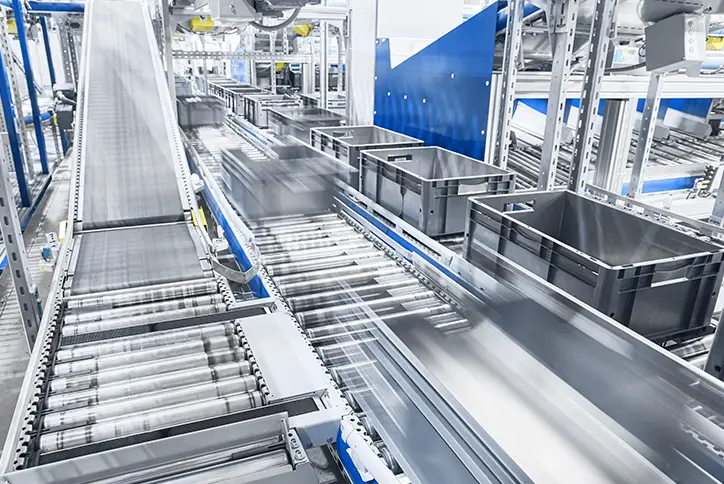

Conveyor and material handling systems move grain, luggage, parcels, manufactured parts, and other products in many industrial and commercial environments. When these systems are well designed and integrated, they can increase throughput, reduce costs, improve uptime, and enhance customer service. Choosing control and automation companies to design, integrate, and support these systems requires a clear review of technical fit, project experience, and support capabilities.
Why These Systems Need Specialized Control Expertise
Conveyor and material handling systems depend on coordinated movement across multiple accumulation zones, transfer points, merges, diverts, and drive assemblies, all of which are managed by photoelectric sensors, switches, scanners, and safety circuits. A logic error or control failure in one segment can spread through the system, leading to downstream blockages, mis-sorts, system alarms, or longer repair times.
This is why PLC programming isn’t enough. Control logic must account for accumulation pressure, indexing sequences, transfer handshakes, alarm handling, and controlled deceleration across integrated equipment. Field devices, VFDs (Variable Frequency Drives), and safety circuits all operate as part of the same flow, synchronized to maintain throughput and prevent nuisance trips. The provider programming the system needs to understand how it behaves under real operating conditions, not just how individual components are wired.
Specialized expertise is also needed at the interface points. Material handling systems often connect with upstream equipment, downstream packaging lines, sortation equipment, operator stations, warehouse systems, or plant-level controls. Those interfaces create risk if logic, communications, or fault handling are poorly defined. A company with direct experience in conveyor and material handling projects is more likely to build controls that are easier to maintain and troubleshoot after startup.
Evaluating Control and Automation Companies’ Experience
Not all control and automation companies’ experience applies equally to conveyor and material handling systems. A company may be strong in general industrial automation but still lack the application knowledge needed for complex conveyor and material-handling systems. Buyers should look for project experience that closely matches their own operating environment, line layout, product flow, and integration requirements.
That evaluation should go beyond whether the control and automation companies have worked with conveyors in a broad sense. Ask what types of systems they have supported. A provider that has designed, programmed, and integrated a system under similar conditions is more likely to have encountered failure modes that matter and can therefore anticipate them, reducing commissioning and maintenance issues.
It is also worth looking at how that experience was applied. Did the company only write PLC code, or did it also handle control panel design, field integration, HMI development, commissioning, and troubleshooting? Did they tie that system to the business enterprise software or provide a new SCADA system? Broader project involvement can be a useful sign that the company understands how the full system operates in the field.
Evaluating Integration and Scope Ownership
Integration is a core part of provider evaluation. Conveyor and material handling systems often depend on communication between conveyors, drives, scanners, operator stations, safety devices, and upstream or downstream equipment. In many cases, they also connect to plant-level controls or software.
Buyers should look closely at how the company defines and manages scope. Problems often happen at handoff points when responsibilities for controls, panels, field devices, and third-party equipment are not clearly assigned. A strong vendor should be able to explain what it will design, what it will integrate, and how it will coordinate with others involved in the project.
Assessing Commissioning and Startup Support
Commissioning and startup are where control logic is tested under actual operating conditions. Control logic that looks complete on paper may still need adjustment once the system is running with real product, real line speeds, and real operator interaction. Buyers should evaluate whether a company can support more than just design and programming.
A qualified vendor should be able to assist with checkout, sequence verification, device testing, fault resolution, and startup tuning. Ask whether the company uses simulation or emulation tools to test layouts, validate control logic, and identify system-level issues before startup. Pre-deployment testing can reduce on-site commissioning time and lower start up risk.
Documentation, Maintainability, and Long-Term Support
Control systems for conveyor and material handling applications need to be serviceable after startup. That means buyers should look beyond initial performance and consider how the system will be maintained, modified, and troubleshot over time. Clear documentation, organized programming, and usable operator interfaces can make a major difference in how quickly plant personnel or service teams can respond when issues occur.
It is also important to understand what support the control and automation companies provide after commissioning. Some provider stop at startup, while others also support troubleshooting, updates, and system changes as operating needs evolve. For systems that cannot afford extended downtime, long-term support should be a factor in the buying decision.
How Kasa Supports Conveyor and Material Handling Systems
Kasa supports conveyor and material handling projects with control system design, PLC programming, upper level SCADA development, control panel fabrication, integration, commissioning, and long-term support. Its published experience includes baggage handling, grain handling, and parcel automation, which align well with systems where sequencing, integration, and startup execution directly affect performance.
Kasa also uses simulation and emulation tools to test mechanical and PLC designs, validate HMI and control behavior, and identify issues before field startup. For conveyor and material handling systems, this approach can limit avoidable downtime and improve readiness before the system goes live.
Contact us to learn how our comprehensive support for conveyor and material handling systems can help ensure your project’s long-term success. Reach out today to discuss your needs and discover how we can optimize your system’s performance.